RETRIDOL Monthly Discourse Series — February 2025
Discourse #42
Hosted by the Regional Training and Research Institute for Distance and Open Learning (RETRIDOL), National Open University of Nigeria (NOUN)
Topic
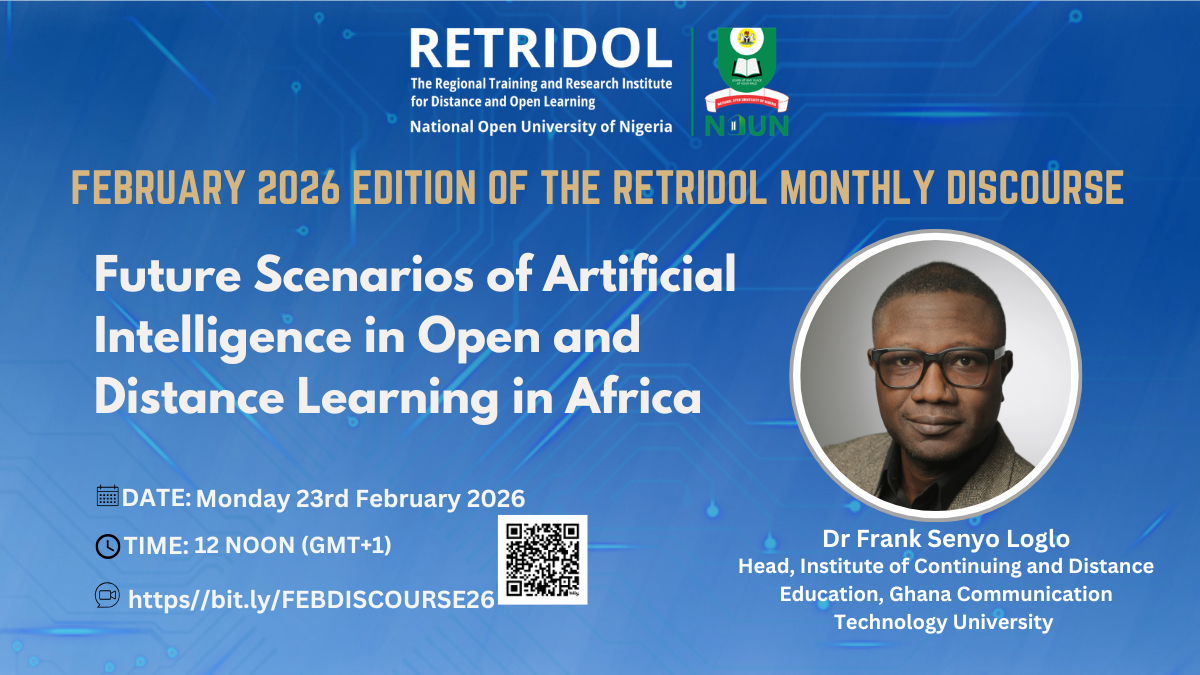
Future Scenarios of Artificial Intelligence in Open and Distance Learning in Africa
This webinar explored future scenarios for the use of artificial intelligence in Open and Distance Learning (ODL) in Africa, focusing on how emerging AI technologies are shaping the next phase of digital education on the continent. The session examined the transformative potential of AI for improving learner support, personalised learning, assessment practices, and institutional decision-making within ODL systems. Particular attention was given to the need for responsible and contextually relevant adoption that strengthens access, quality, and innovation across African universities and distance education providers.
Learning Highlights
- ›Emerging AI applications in Open and Distance Learning
- ›Opportunities for personalised learning and enhanced learner support
- ›Ethical considerations, governance, and responsible AI adoption
- ›Infrastructure and capacity challenges facing African institutions
- ›Strategic approaches for integrating AI in teaching and assessment
Key Questions Discussed
- ›What future scenarios can be anticipated for AI in African ODL systems?
- ›How can universities integrate AI while maintaining equity, quality, and academic integrity?
- ›What policy and governance frameworks are needed to guide AI adoption?
- ›How can institutions prepare staff and students for AI-enabled learning environments?
Date
Monday, 23rd February 2026
Time
12:00 Noon WAT
Speaker
Dr Frank Senyo Loglo
Head, Institute of Continuing and Distance Education, Ghana Communication Technology University
Dr Loglo’s work focuses on digital learning innovation, open and distance education systems, and the integration of emerging technologies in higher education across Africa. He actively contributes to research and professional discussions on technology-enabled learning and capacity development in distance education.
0 Comments